Evolve in the field of entrepreneurship! ► We provide practical and interdisciplinary education focused on entrepreneurship and idea incubation for undergraduate and postgraduate students, scientists and other employees from all over Charles University, as well as for the general public as a part of the lifelong learning program.
Each of our courses is unique in its connection to practice and can serve as a complement or extension of curricula across disciplines and faculties. Why entrepreneurship?
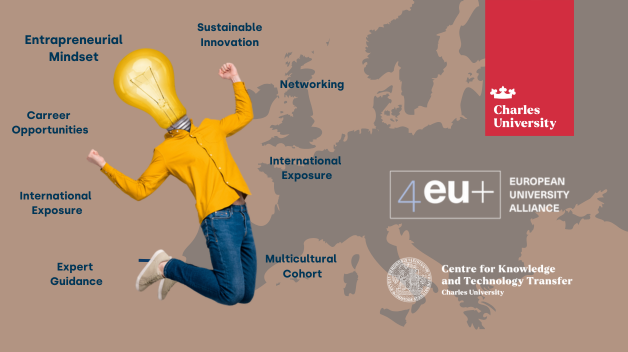
Seven month prestigious Diploma is aimed at young postgraduates and doctoral students at Charles University who want to learn project management with a view to:
working as an intrapreneur in a large company,
joining a start-up,
or participating in the development of an association or organisation involved in the social economy or environmental transition.

For the upcoming semester, we are opening two specialized educational courses focused on developing an entrepreneurial mindset, transversal skills, and the transfer of scientific knowledge into practice.
The offer is intended for PhD students, supervisors, tutors, as well as academic and research staff.
Instruction in both cases is conducted in the English language.
Fostering Entrepreneurial Mindset & Transversal Skills (4EU+ Alliance)
An international online course within the 4EU+ Alliance designed primarily for tutors, supervisors, and interested PhD students across the 4EU+ Alliance. The aim is to equip academics with the skills required for effective leadership, team motivation, and fostering an entrepreneurial mindset in an academic setting.
Format: 5 online modules with worksheets in the Moodle environment + a final live module (live online meeting).
Certification Requirement: Submission of all worksheets and participation in the final online meeting.
Expression of interest form: here.
Language: English
Free of charge.
Course Modules Overview:
Module 1:
Unveiling Innovation and Entrepreneurship
Entrepreneurship as a learnable competence (EntreComp framework), viewing your research through societal impact, and identifying value beyond purely academic outputs.
Module 2
The Problem Is Not What You Think - How to challenge assumptions before jumping to solutions
Fall in Love with the Problem, Not the Solution focuses on one of the most important – and often underestimated – stages of innovation: deeply understanding the problem before developing solutions. Academics, researchers, and students are trained to solve complex problems, but expertise and cognitive biases can also encourage premature assumptions about what the real problem is. This module explores why a problem statement should be treated as a hypothesis rather than a fact and how tutors can help students distinguish assumptions from evidence. Participants learn how desk research and AI can be combined with real-world investigation through doing, observing, and interviewing. Particular attention is given to conducting interviews without unintentionally validating an existing idea or solution. Through practical examples, participants experience how surprising evidence can lead to a fundamentally different understanding and reframing of a problem. The module equips tutors with practical methods to foster curiosity, patience, critical thinking, and a problem-first mindset in their students.
Module 3:
Design Thinking in Life and Pedagogy
This 20-minute session applies core Design Thinking principles directly to the tutoring experience. Participants map their key energy drivers and drains, reframe an everyday challenge into a clear focal question, and map out a practical 48-hour test. A focused introduction connecting agile methodology with everyday self-management and course delivery.
Cheng-Wen Jaw is Entrepreneurship Education Manager at hei_INNOVATION, the transfer agency of Heidelberg University, as well as Design Thinking Facilitator and Entrepreneurship Lecturer at Heidelberg University – there, since November 2024, he has been responsible for curriculum development, workshops, and summer schools in Chile and India. Previously, he worked as a Startup Advisor at BTU Cottbus-Senftenberg.
Module 4:
Mentoring Without Taking Over
Navigating the core dilemma of mentoring: guiding students to find their own path without micromanaging, including actionable coaching questions.
Module 5:
Pitch Perfect: From Concept to Delivery
Coming up with a great idea is only half the battle — knowing how to deliver it to the right audience is what makes it land. In this module, we'll walk through the process of crafting the perfect pitch, from initial idea to final presentation. Along the way, we'll cover structure, language, and visual design, as well as body language and the techniques that help you stand out.
Eliška Jandová is a PhD candidate at Charles University's Faculty of Medicine in Pilsen, where her research focuses on hematological malignancies. In 2022, she was named first runner-up in the international FameLab science communication competition, and she has been active in scicom ever since — hosting a podcast, creating science content for social media, and leading workshops on presentation skills. Apart from her research she focuses on teaching not only scientists how to deliver tough topics to the general public.
Module 6
Reflection and Bridging Practice with Academia (Live online session)
Final reflection, sharing plans for implementing knowledge into practice, supplemented by a guest lecture from the Lifelong Learning Centre and the Chamber of Commerce Ing. Radek Čajka, Ph.D.
From Idea to Realization
A university-wide, non-credit practical course created by the Centre for Knowledge and Technology Transfer (CU TTO). The program is open to PhD candidates across all 17 faculties of Charles University, as well as academic and research staff.
The objective is to guide participants in viewing their research through the lens of market and societal impact and navigate the full lifecycle of technology transfer and commercialization — from initial concept to startups and spin-off companies.
Venue: Kampus Hybernská, Building D, Room D2 (Hybernská 4, Prague 1)
Format: Sequential thematic blocks (meetings approx. once a week, 2–3 hours per session)
Certification Requirement: Attendance is mandatory at all sessions, with an allowance of one absence.
If you wish to participate, please register via SIS. Registration opens on September 24, 2026.
Language: English
Free of charge.
Thematic Focus of Individual Blocks:
19. 10. 16:00 - 19:00
Idea Discovery and Identification
Jiří Zhoř (co-founder of Rostutu, former research commercialization consultant at JIC, Vilgain), Veronika Štěpánková (biochemist from Masaryk University, startup business consultant at JIC, and co-owner at Enantis)
In this session, we will explore how to identify ideas with genuine potential, how to recognize whether research can translate into a viable, real-world solution—one that addresses a concrete problem people are actually willing to pay for—and how to take the first practical steps to develop it.
22.10. 16:00 - 19:00
Validation of commercial potential
Julie Levková (Research Innovation Manager SIC)
A workshop dedicated to assessing the commercial and social impact potential of research: defining the problem statement and research value proposition, evaluating technology and customer readiness levels, identifying key target audiences and competitive landscapes, and verifying real market need and pathways to implementation.
5. 11. 14:00 - 17:00
Intellectual Property and Forms of Commercialization
Nikola Minks (Patent Expert at CU TTO)
Legal and strategic fundamentals of intellectual property protection (patents, utility models, know-how, copyright). Comparison of key commercialisation pathways (licensing vs. founding a spin-off vs. contract and collaborative research), alongside an introduction to the support ecosystem available directly at Charles University.
12. 11. 15:00 - 18:00
From Methodology to Story: Pitching Your Idea So People Understand and Believe It
Markéta Kaclová (Strategic Communication Centre, Faculty of Social Sciences, Charles University), Stanislava Lindenthalová (Second Faculty of Medicine, Charles University)
A two-hour workshop on how to present your research or business idea clearly and precisely to decision-makers—whether an investor, partner, or grant committee. In the first hour, every participant clarifies the four pillars that underpin any pitch, from investor slides to an informal hallway chat: what concrete action you want the other person to take after the conversation; who is sitting across the table, what they decide on, and what they are afraid of; what actually changes and for whom thanks to your research—turning a dry description of methodology into a compelling story; and why now, and why you.
The second hour focuses on practice: a 90-second pitch in small breakout groups, followed by Q&A and immediate feedback based on three clear criteria. Participants will walk away with an articulate core message, a well-defined negotiating position, and a battle-tested short pitch. (Please bring a specific project or research proposal with you.)
19.11.2026 14.00 - 16:00
Start-up Founder and Investor
Martin Schmid (EquiLibre Technologies), Jakub Křikava (Credo Ventures)
The collaborative dynamic between a startup founder and investor. This session will take the form of an interactive workshop and lecture with an open discussion, giving students firsthand insight into the speaker's personal journey and real-world experiences in translating deep tech research into business. Together, we will examine the key challenges and pitfalls of launching a startup as well as strategies for communicating with investors. The session will also provide practical advice for early-career researchers on how to uncover the practical application potential of their work and successfully align academic expertise with market demands.
26.11.2026 14:00-16:00
A Successful Charles University Spin-off
Lukáš Kolek (Charles Games)
This session will focus on practical lessons learned and key aspects of technology transfer encountered along the way. It will also provide ample room for students' specific questions and topics—whether general or tailored to their own projects.
We reserve the right to make any changes or modifications.
► Are you considering starting your own business based on the latest scientific knowledge? Need advice on your project? We are here for you!
► Based on the consultation, we will advise you on how to proceed - we will prepare individual training for you and recommend mentors.
► Consultations are free of charge for all Charles University students and staff.
► Contact us -
The Centre for Knowledge and Technology Transfer of the Charles University
Office address:
Petrská 1180/3
110 00 Prague 1
Telephone: +420 224 491 255
E-mail:
Mailing address:
Ovocný trh 560/5
116 36 Prague 1
Czech Republic
IN: 00216208
TIN: CZ 00216208